Kyle Elite Concrete has taken on concrete repair in Kyle, TX for more than 20 years, serving surrounding cities including Buda, San Marcos, Manchaca, Shady Hollow, Redwood. Two decades on this ground is the reason we open a repair job by asking what moved rather than by quoting a price per square foot.
Concrete repair covers a wide spread of work: sealing a crack that is only going to widen, injecting one that is carrying load, cutting out and replacing a failed section, and restoring a surface that has lost its top layer. The methods are not interchangeable, and the wrong one applied to the right problem buys a season.
There is a local reason to take this seriously. Kyle’s final building inspection calls out cracking and crazing as failure conditions rather than as cosmetic complaints, and the expansive soils the city names in its own ordinances are what put most of those cracks there. A repair that ignores the soil is a repair with an expiry date.
What Is Actually Wrong With the Slab
Cracks That Moved and Cracks That Did Not
A crack with both faces level and tight is shrinkage doing what shrinkage does, and it needs sealing rather than surgery. A crack with a lip, where one side sits higher than the other, means the support under the slab is no longer even. We check for that displacement with a straightedge before recommending anything, because the two conditions cost very different amounts to put right.
Spalling, Scaling and Surface Loss
Spalling is concrete breaking away in flakes or chunks, usually at an edge or around embedded steel, and scaling is the top layer peeling off across an area. Both expose more surface to water, and near reinforcing both accelerate once they reach the bar. We sound the area to find how far the loose material extends, since the repair boundary is always wider than the visible damage.
Crazing and the Slab Below It
Crazing is a fine web of surface cracks left by a cure that dried faster at the top than the concrete below it, and on its own it is shallow. What matters is whether the slab underneath is sound, because a crazed surface on a solid slab is a candidate for an overlay while a crazed surface over a cracked slab is not. We establish which before quoting a finish.
Repair Methods We Use
Crack Chasing and Joint Sealant
Crack chasing opens a narrow crack into a clean, uniform channel that a sealant can actually bond to, rather than smearing material over a feature that will telegraph straight back through. We follow it with backer rod and a flexible joint sealant where the crack will keep moving with the seasons. On a slab over Vertisol clay, assuming further movement is the safe bet.
Epoxy Injection for Structural Cracks
Where a crack passes through the slab and the two sides still need to act as one, epoxy injection bonds them back together and restores continuity across the break. It is a structural repair, not a cosmetic one, and it only works on a crack that has stopped moving. We confirm the movement has stopped before injecting, because epoxy in an active crack simply cracks again beside the repair.
Partial Depth and Full Depth Repair
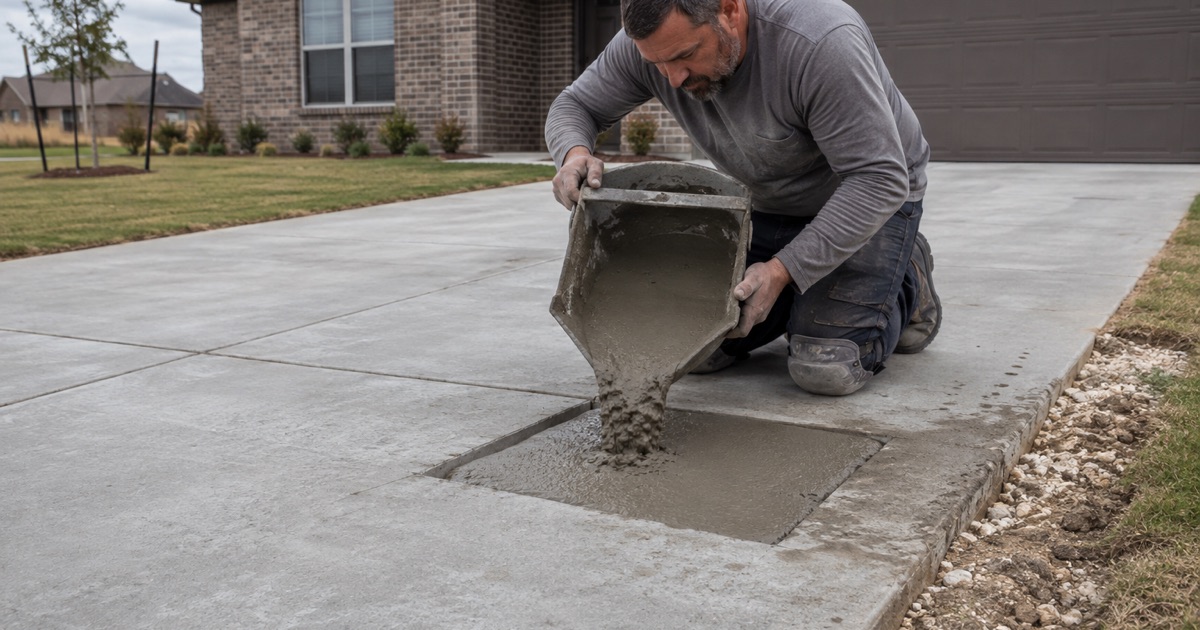
Partial depth repair removes the damaged upper portion and rebuilds it where the lower slab is still sound, and it suits spalled edges, scaled areas and shallow surface loss. Full depth repair takes the section out to the subgrade and replaces it, reinforcing included. The choice comes down to how far the damage reaches, which is a question we answer by opening a small area rather than guessing.
Repair Against Replacement
When a Section Replacement Wins
There is a point where patching a slab costs more over five years than cutting out the bad section and pouring it again, and it arrives sooner than most owners expect. A slab that is thin, under-reinforced or broken in several places is usually past it. We put both numbers in front of you with the service life each buys, and we do not pretend the cheaper line is always the better one.
Tear Out, Saw Cutting and Core Drilling
A clean replacement starts with a clean edge, which means saw cutting to a straight line at full depth rather than breaking concrete back to a ragged margin. Core drilling lets us take a plug to confirm thickness and check what is under the slab before committing to a scope. Both cost a little time at the front and remove most of the surprises later.
Matching a Repair to Concrete Already Down
New concrete placed against cured concrete will not match on day one, and anybody who tells you otherwise has not done many of these. We can get close on color, aggregate and finish, and the patch will migrate toward the surrounding slab over the first year. Where an exact match matters more than cost, resurfacing the whole area is the honest answer.
Repair Work on Kyle’s Expansive Ground
Repairs That Fail Because the Soil Was Not Addressed
Most repeat repairs we are called back to look at were competent pieces of concrete work placed over a cause nobody dealt with. Houston Black clay under a driveway can move enough across one dry summer to reopen a sealed crack in the same line. We look for the mechanism first, because a repair that does not account for it is a scheduled return visit.
Foundation Movement and the Engineered Design Rule
Where movement has reached the foundation rather than the flatwork, Kyle requires an engineered and permitted design, and the city states the reason plainly as the expansive soils in Kyle. That means pier, footing and grade beam work built to a sealed engineer letter rather than to a contractor’s judgment. We work to that design and say so on the proposal rather than working around it.
Drainage and Joint Sealing as Repair Insurance
Water is the delivery mechanism for nearly every failure on this page, whether it is washing fines out of a base or swelling clay against a slab edge. Sealed control joints and expansion joints, plus grades that move water away from the concrete, are the cheapest work available here. We usually recommend them alongside a repair, because they are what stops the next one.
Our Step-by-Step Concrete Repair Process
Site Look and Cause Diagnosis
We start on site with a straightedge, a sounding tool and a look at where water goes, and we identify the mechanism before naming a method. Nothing gets quoted from a photograph. What you get out of this visit is a plain description of what is wrong and what put it there.
Written Scope and Method Selection
The proposal names the method for each area, the materials, the boundaries of the work and what is deliberately excluded. Where two methods are defensible we price both. That way the decision about how much to spend stays with you rather than being made quietly in the field.
Saw Cutting and Removal
Removal is cut to line at full depth, and material comes out without disturbing the sections that are staying. We check the subgrade and base once the slab is off, because that is the only moment they are visible. If compaction is poor, we fix it then rather than pouring over it.
Placement, Finish and Cure
The repair is placed to the specified thickness with reinforcing tied and chaired, finished to match the surrounding surface, and cured deliberately. In Kyle heat that means an evaporation retarder or a curing compound rather than leaving it to the afternoon. We give you the date the area comes back into service before we leave.
- 20+ Years in Hays County
- Insured & Permitted
- Free Estimates