Concrete Contractor in Kyle, TX

Driveways, slabs, patios and repairs built to the Kyle detail that governs your job, on ground we price before we price the concrete.

Kyle Elite Concrete has been placing concrete in Kyle, Texas for more than 20 years, covering driveways, slabs and pads, patios, pool decks, sidewalks, stamped and decorative work, resurfacing, leveling and repair. We work residential and commercial, and we take the permitted work as readily as the flatwork that needs no permit at all.

What separates a slab that holds from one that opens up in its third summer is almost never the concrete. It is what was under it and what was in it. Just over half of Kyle sits on Mollisols and just under 40 percent on Vertisols, so the honest answer to what is beneath your slab is that it depends on the address.

That look decides the rest of the job. Houston Black clay under one street carries a plasticity index of 44 and a linear extensibility of 12.0 percent, while Real gravelly loam a few streets away sits at a plasticity index of 18 and moves between 1.0 and 2.1 percent. The reinforcing, joint spacing and base all follow from which one you have.

Get Your Free Quote

Fast response • No obligation

So we can reach you about your request.

So we can send you a confirmation after you submit this inquiry form.

  • 20+ Years in Hays County
  • Insured & Permitted
  • Free Estimates

What we do

Our Services

Concrete contractors in Kyle, Texas

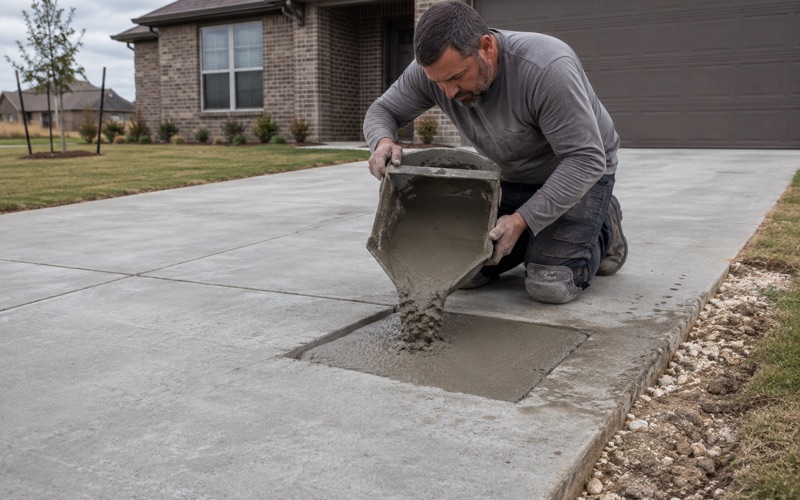
Repair mortar being placed into a saw cut patch in an older concrete driveway in Kyle, sound concrete showing in the base of the patch.

Concrete Repair

Crack sealing, epoxy injection, spall and scaling repair and full depth section replacement for concrete in Kyle, TX.

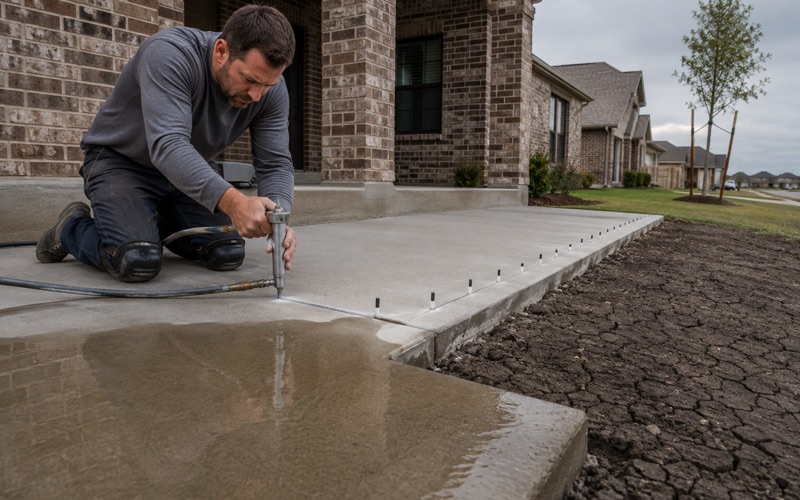
Polyurethane foam being injected through drilled ports to lift a settled concrete walk in Kyle, the step across the joint still showing.

Concrete Leveling

Foam injection, mudjacking and void fill to lift settled driveways, walks, patios and commercial slabs in Kyle, TX.

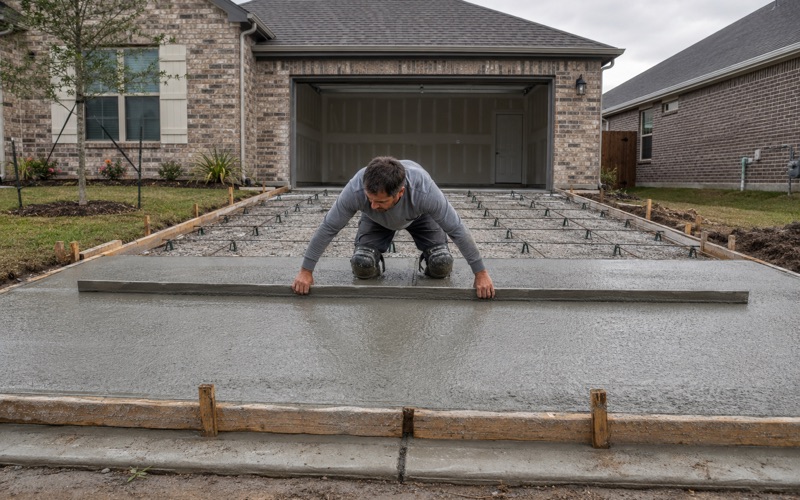
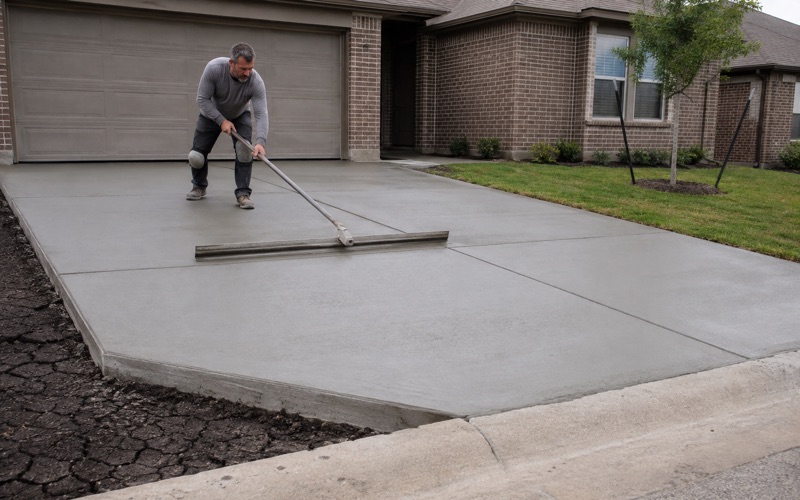
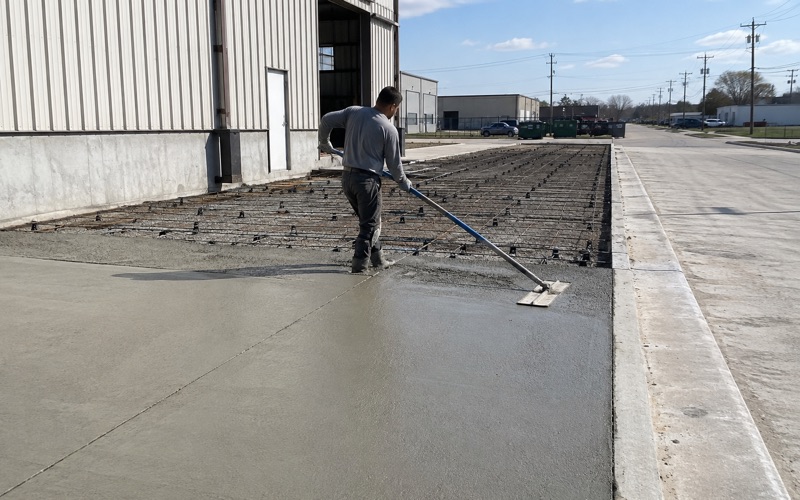
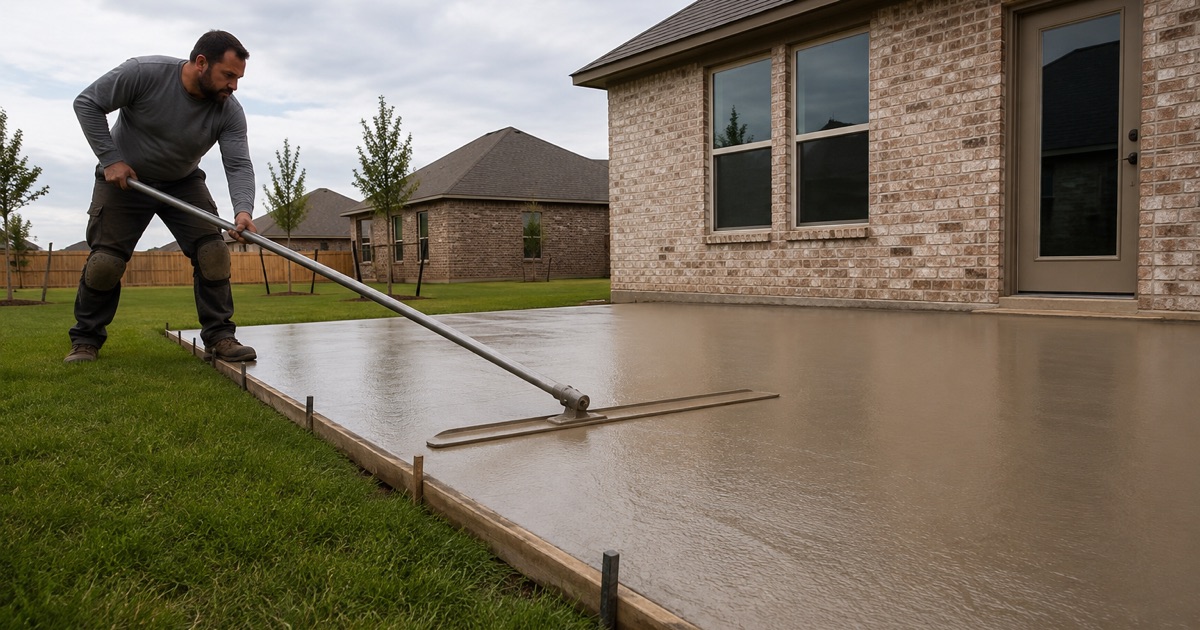
A screed board being drawn across a freshly placed concrete driveway in Kyle, the centerline expansion joint board standing in the wet slab.

Concrete Driveway

New and replacement concrete driveways in Kyle, TX, built to the city checklist or adopted standard detail with the permit pulled.

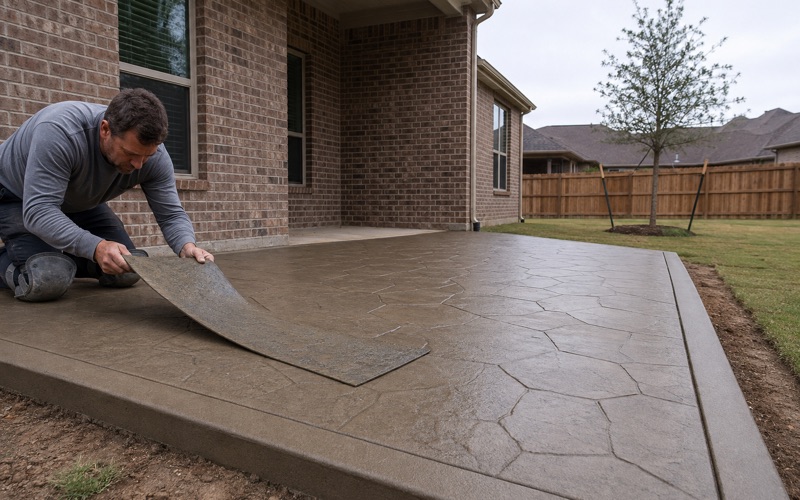
A stamp mat being tamped into green colored concrete on a Kyle patio, the pattern running crisp behind it.

Stamped Concrete

Stamped concrete patios, pool decks, walks and driveways in Kyle, TX, with pattern, color and joint layout designed together.

A vapor retarder sheet being rolled out over the base course of a formed shop pad in Kyle, the reinforcing bar bundled beside it.

Concrete Slab

Concrete slabs and pads in Kyle, TX for shops, sheds, RV parking, generators and equipment, specified by the load they carry.

A broom finish being drawn across a green concrete patio in Kyle, the textured half and the smooth half meeting in a clean line.

Concrete Patio

Concrete patios in Kyle, TX, laid out around the furniture, isolated from the house slab and finished for a Texas summer.

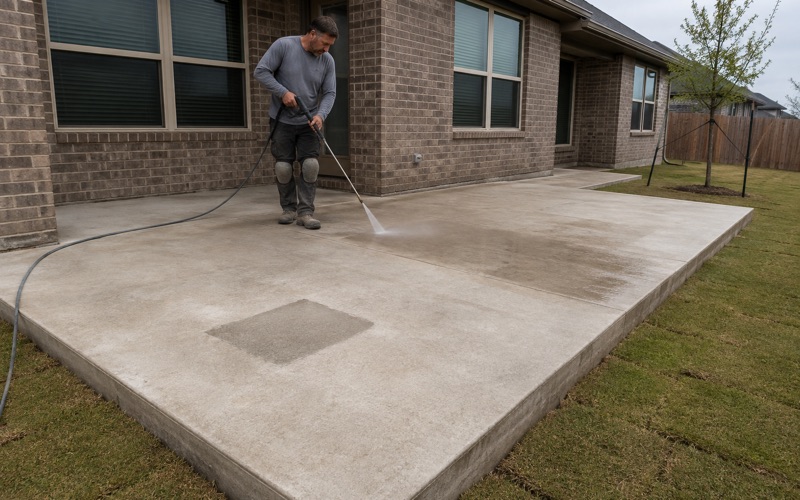
A polymer overlay being spread across a prepared concrete pool surround in Kyle, the pulled half reading darker than the bare slab ahead of it.

Concrete Resurfacing

Microtoppings, textured overlays and self leveling underlayment for sound slabs in Kyle, TX, with the substrate tested first.

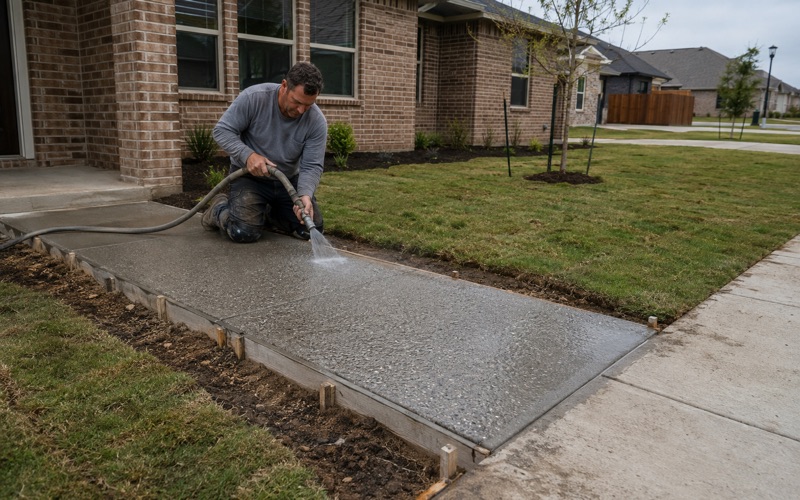
An exposed aggregate finish being washed out of green concrete on a Kyle walk, the stone showing behind the wash line.

Decorative Concrete

Integral color, stains, exposed aggregate, salt finishes, sawcut scoring and polished floors for concrete in Kyle, TX.

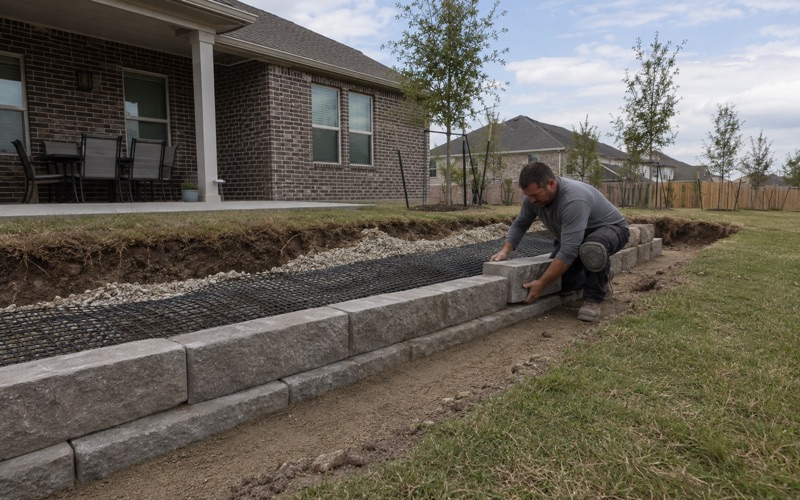
A precast concrete segmental retaining wall going up course by course in Kyle, the drainage stone and the first course showing behind it.

Concrete Retaining Wall

Cast in place concrete retaining walls in Kyle, TX, with engineered design where height or surcharge requires it.

Cast concrete coping being set on the bond beam of a new pool in Kyle, the formed deck slab running away behind it.

Concrete Pool Deck

Concrete pool decks in Kyle, TX built for wet traction and Texas surface temperature, with the pool shell joint detailed properly.

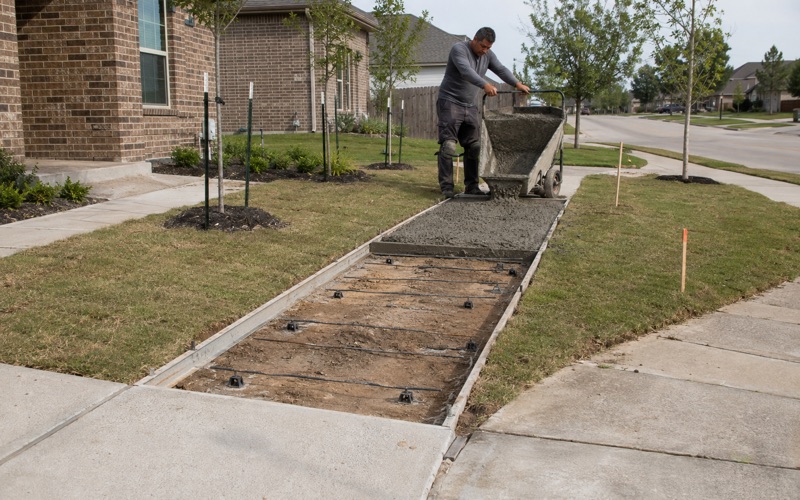
Concrete being placed from a buggy into a formed right of way sidewalk in Kyle, the forms and the drive approach running away behind it.

Concrete Sidewalk

Right of way sidewalks, curb ramps and private walkways in Kyle, TX, built to measured accessibility tolerances.

A dowel basket being set at a construction joint in a commercial truck apron in Kyle, the formed pavement running away toward a loading dock.

Commercial Concrete

Commercial parking lots, drive aisles, container pads, curb and gutter and slabs in Kyle, TX, phased around an operating site.

Twenty Years of Concrete in Kyle and Hays County

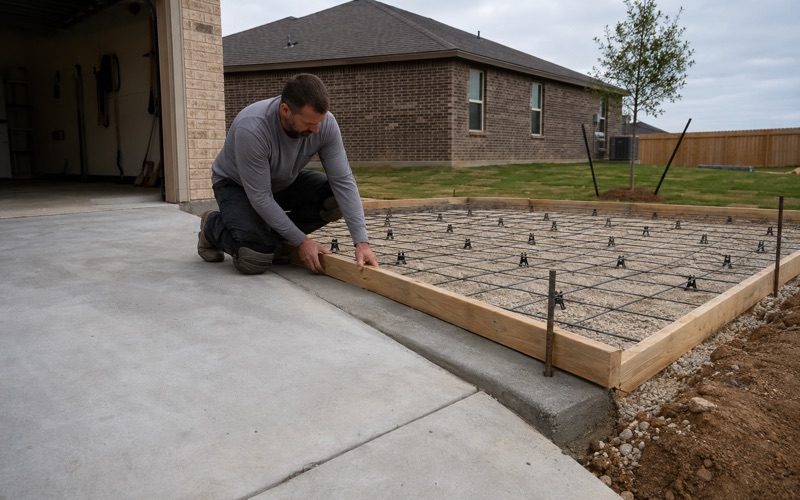
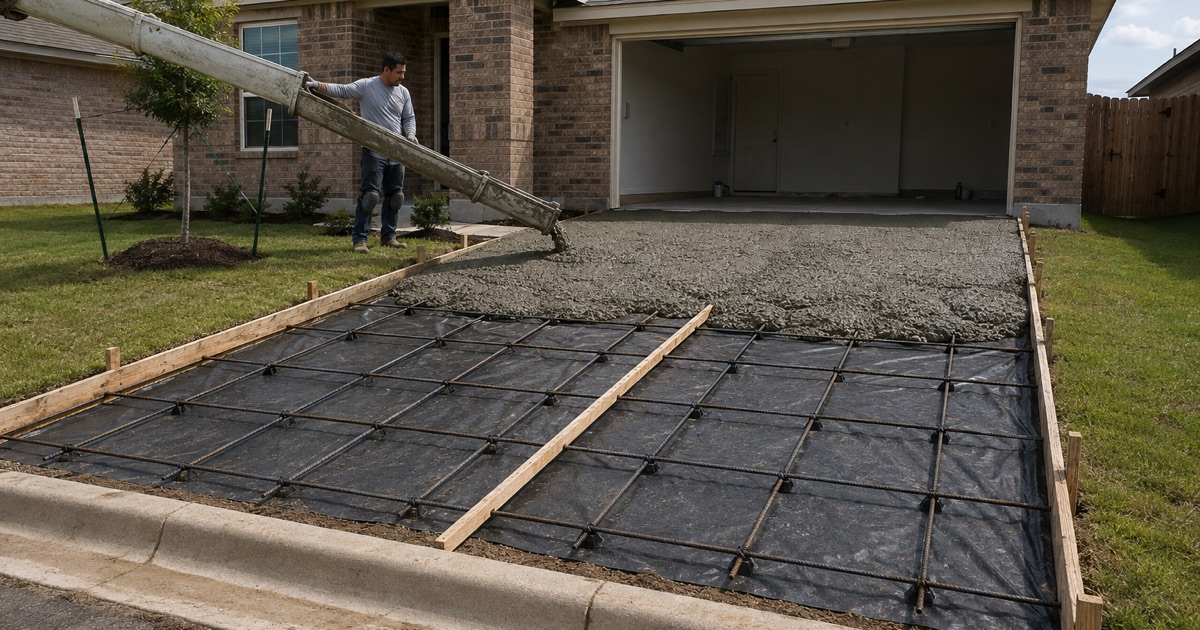
Concrete being discharged from a ready-mix chute into a formed driveway in Kyle, the reinforcing bar still showing on chairs ahead of the pour.

Two Decades on the Interstate 35 Corridor

Twenty years and more of concrete placed in Kyle and the Hays County corridor along Interstate 35 means the ground here is not a surprise to us. We have poured on the black clay and on the shallow gravelly loam over limestone, watched both through dry summers, and seen which details held. That history is why we price the ground before the concrete.

Why Choose Kyle Elite Concrete

Soil Priced Before Concrete

Every bid starts with what is under the slab rather than what goes on top of it. Houston Black clay under Kyle carries a plasticity index of 44 against 18 for Real gravelly loam a few streets over, so the reinforcing and joint layout match ground that will actually move rather than a detail copied off the last job.

No Banned Substitutions

Hog panels, welded wire fabric and fibrous concrete never stand in for the bar on our driveways, and broken brick or rock never serves as a chair. Kyle names all four as prohibited, so your approach passes on the first look rather than coming apart at a reinspection you pay for.

Inspection Booked Before the Pour

Kyle inspects flatwork twice, and we schedule the right of way inspection ahead of the truck rather than after the concrete is down. A failed final adds a reinspection fee on top of the original cost, so the checklist gets satisfied while a correction still costs an hour rather than a tear out.

The Governing Document Named

No proposal leaves here without naming which Kyle document the job is built to. The residential driveway checklist specifies minimum Class A concrete at 3,000 psi, 5 inches through the approach and number 3 bar at 18 inches on center on chairs at mid-depth, while the adopted standard detail calls for 6 inches and number 4 bars both directions.

Aquifer Line Checked First

We confirm which side of the Edwards Aquifer boundary an address falls on before any earthwork is scheduled. TCEQ maps put 26.5 percent of Kyle in the Recharge Zone and 21.4 percent in the Transition Zone, and plan approval attaches on one side and not the other, so the calendar accounts for it rather than stalling mid job.

Driveway Kept Clear

Each approach we form stays at least 10 feet off a storm sewer inlet, and no water meter box, water main valve or wastewater cleanout ends up inside the drive. Kyle requires all four clearances, so the utility somebody has to reach in five years is still reachable rather than buried under new concrete.

New Concrete, and the Ground It Goes On

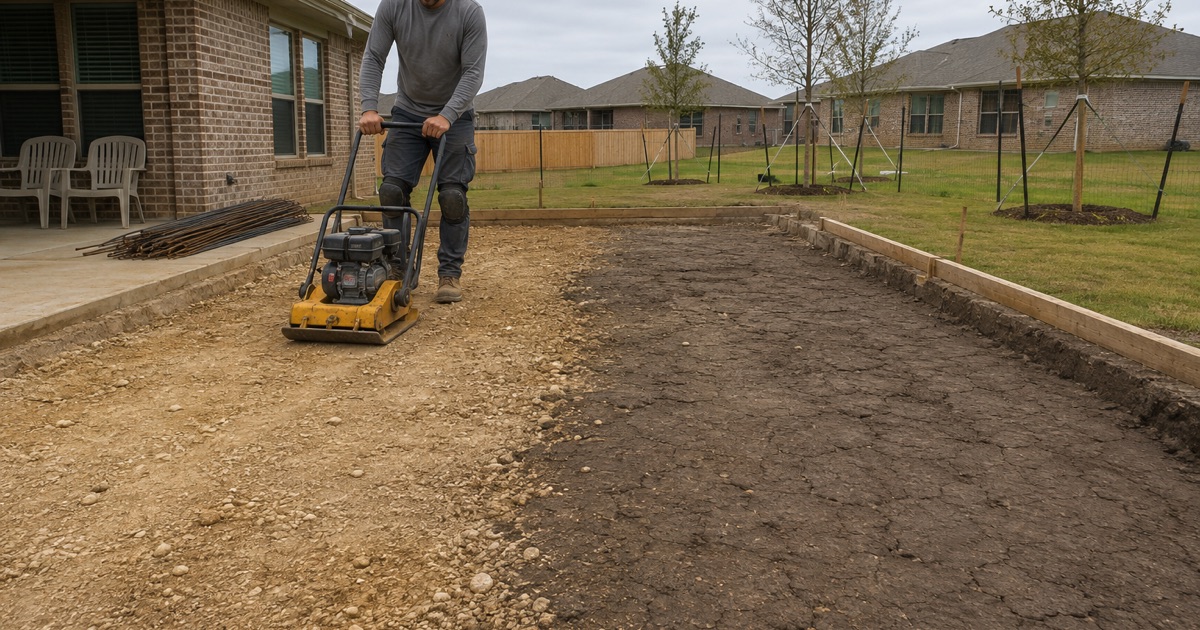
A plate compactor being walked across the base course of a formed slab in Kyle, the two grounds of the city showing in the open cut beside it.

Concrete Installation From First Look to Drive-On Day

A new pour starts with a walk of the site to confirm what the subgrade actually is, and ends when the slab has cured enough to carry a vehicle. Between those two points sit the base, the reinforcing, the joint layout and the cure, each set on paper before a truck is ordered.

Soil Mapping Before the Concrete Bid

The right answer changes street by street in Kyle, with Mollisols under about half the city and Vertisols under most of the rest. We identify which series is under your address rather than assuming the one under the last job, because the two want different reinforcing and different joint spacing. A bid written without that step is a guess wearing a number.

Expansive Clay and a Plasticity Index of 44

Houston Black clay swells when it takes on water and shrinks hard when it dries, and at a plasticity index of 44 with a linear extensibility of 12.0 percent it moves enough over a dry summer to lift and drop a slab at its corners. We detail for that movement with bar sized and placed to hold the slab together through it.

Real Gravelly Loam and Limestone Residuum

Shallow gravelly ground over limestone looks like the same dirt from the street and behaves nothing like it, at a plasticity index of 18 and moving 1.0 to 2.1 percent. It carries load well and drains, but rock outcrop and a root restricting layer can turn a routine excavation into saw work. We probe before we price so the excavation line in your proposal is real.

Concrete Driveways That Cross the Right of Way

A residential driveway is two jobs with one finish: the private portion on your property, and the approach crossing the public right of way under the city’s rules. Public Works requires a right of way excavation permit to replace an existing driveway or sidewalk, and the approach is built to the city’s detail rather than yours. We pull that permit and carry the approach to spec.

The Kyle Residential Driveway Checklist

Kyle’s residential driveway checklist sets minimum Class A concrete at 3,000 psi, 5 inches through the approach and number 3 bar at 18 inches on center on chairs at mid-depth. The standard detail the city has adopted for driveways goes further, calling for 6 inches and number 4 bars both directions. We tell you which one governs your job before you sign.

Concrete Slabs and Equipment Pads

Shop floors, shed bases, RV parking, generator pads and equipment pads are all slab on grade work, but the load and the loading pattern differ enough that one thickness does not cover them. A generator sits still and concentrates its weight; an RV rolls a heavy axle onto the same edge every time. We size thickness, base and reinforcing to what the slab will actually carry.

Subgrade, Flexible Base and Vapor Retarder

Under the concrete goes a prepared subgrade, then a compacted flexible base course, then a vapor retarder where the slab will be enclosed or finished. Compaction is verified against proctor density, and a 10 mil vapor barrier meeting ASTM E1745 is the capillary break that stops moisture rising through a finished floor. Most slab failures we are called to repair started in this layer.

Rebar Against Fiber Mesh and Welded Wire Fabric

Macro synthetic fiber and welded wire reinforcement control shrinkage cracking, while deformed bar holds a cracked slab together and carries load across the crack. On Kyle driveways the question is settled for you: the city bans hog panels, wire mesh and fibrous concrete as substitutes for the bar, and bans broken brick or rock as chairs. We place number 3 or number 4 bar on proper chairs at mid-depth.

Hot Weather Concreting and Curing Control

Pouring in Texas heat raises the evaporation rate at the surface faster than bleed water can replace it, and that is what produces plastic shrinkage cracking and crazing in a slab that was otherwise fine. We pour to the conditions, using an evaporation retarder and a curing compound or wet cure as the day demands. Kyle’s final building inspection calls out cracking and crazing as failure conditions, so the cure is not cosmetic.

When Concrete Cracks, Sinks or Lifts

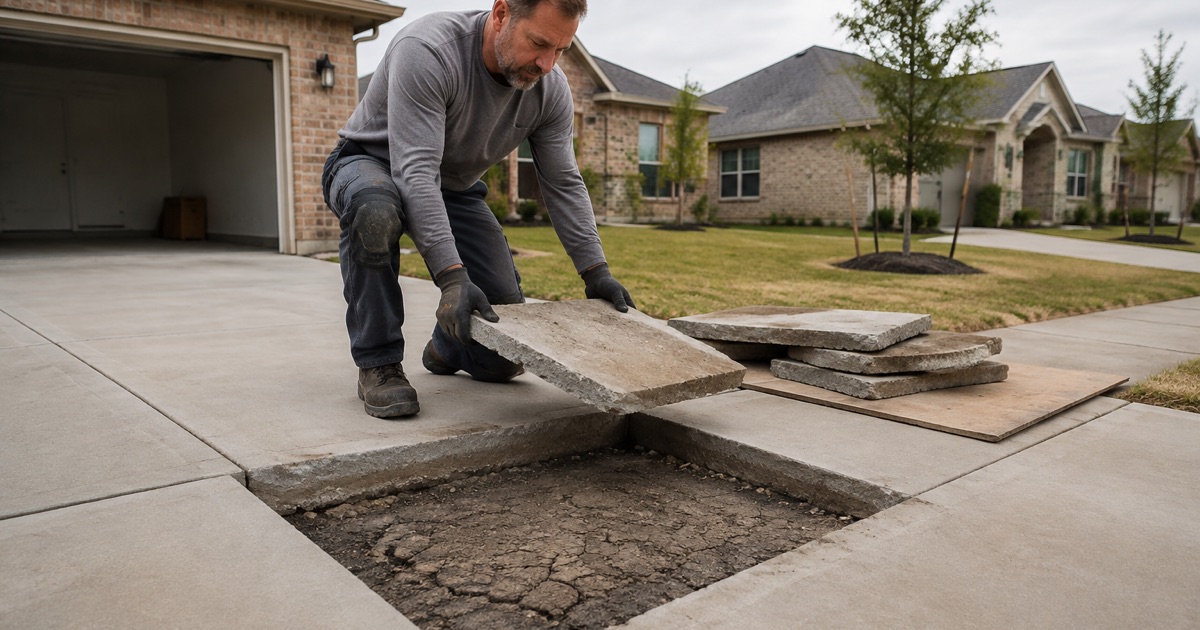
A failed section of concrete driveway being lifted out in pieces in Kyle, the four inch edge showing in section and the clay subgrade open underneath.

Why a Concrete Driveway Sinks

A sinking driveway is almost never the concrete failing; it is the support under it leaving. Water finds a path along a joint or an edge, carries fines out of the base, and the slab spans the void until it cannot. We find where the water is getting in before we lift anything, because a slab raised over an unsealed entry point sinks again on the same schedule.

Reading Cracks in a Slab on Grade

Hairline crazing on the surface is a finish and cure issue, a straight crack that follows a sawcut joint is the slab doing what it was told, and a wide crack wandering across the middle with a lip on one side means the ground moved. We tell you which you have and what it costs to leave it alone.

Concrete Leveling Against Full Tear Out

Leveling is right when the slab itself is sound and has simply lost its support, and a tear out is right when the concrete is broken through, badly scaled or too thin to lift without cracking. We give you the case for both rather than the one that suits our week.

Mudjacking and Polyurethane Foam Injection

Mudjacking pumps a cementitious slurry under a slab and is well suited to heavy sections where added weight is not a concern. Polyurethane foam injection is lighter, sets in minutes and travels through smaller holes, which makes it the better answer on weak subgrade and on surfaces you need back in service the same day. Both are slab stabilization; the void fill material is what changes.

Trip Hazard Repair for Landlords and Associations

A lifted joint that catches a toe is a liability item, and the property owner or the association typically carries it long before the city does. Partial depth repair, grinding or leveling can all bring a lip back into tolerance depending on how much displacement there is. We measure the displacement and document what was done, because the record matters as much as the repair.

Crazing, Scaling and the Slab Underneath

Crazing is a fine map of surface cracks from the cure, and scaling is the top layer flaking away. Neither necessarily means the structural slab is compromised, though both expose more surface to water and both get worse once they start. We core or sound the slab where it matters so the recommendation rests on the condition below the surface rather than on what it looks like.

Concrete Resurfacing and Overlay Conditions

A concrete overlay, microtopping or self leveling underlayment can give a tired slab a new surface, but only if what is underneath is stable, clean and sound. An overlay laid over a slab that is still moving telegraphs every crack through within a season. We test the bond and check the movement first, and we will tell you when a slab is not a candidate.

Joint Resealing Before Water Gets Under

Control joints and expansion joints are supposed to open, which is why they are filled with a backer rod and joint sealant rather than left as a gap. Once that seal fails, surface water goes straight into the base and starts moving fines.

Engineered Foundation Repair in Kyle

Foundation work here is engineered and permitted, and the city says why in its own words: because of the expansive soils in Kyle. That means a sealed engineer design rather than a contractor’s judgment, and pier, grade beam and footing work built to that design. We work to the engineer’s letter rather than around one, and we say so on the proposal.

Concrete Repair Against Replacement, in Numbers

The repair or replace conversation should be arithmetic, not a sales pitch. We price both, note how much service life each buys given what the slab and the subgrade are actually doing, and leave the comparison with you.

Decorative Concrete and Finishes

A bull float being pushed out across a freshly placed integrally colored concrete patio in Kyle, the forms still standing on both sides.

Stamped Concrete Patterns That Age Well

Stamped concrete takes a texture and a release agent while the slab is still plastic, and the patterns that still look right in ten years are the ones with enough relief to hold color in the low points as the surface wears. Tight, shallow patterns flatten out first. We steer toward the ones that age rather than the ones that photograph best on day one.

Integral Color, Color Hardener and Acid Stain

Integral color goes through the whole batch and never wears off, color hardener sits in the top layer and gives a denser, brighter surface, and acid stain reacts with the concrete for a variegated finish that is never quite repeatable. Water based stain and dye give more control and less depth. Which you want depends on how much wear the surface will take.

Broom, Float, Trowel and Salt Finishes

A broom finish gives dependable traction and belongs on driveways and walks, a float finish leaves an open texture, a trowel finish closes the surface tight for interior slabs, and a salt finish opens small pockets for grip and character. We match the finish to where the slab is and who walks on it.

Exposed Aggregate and How Much Stone Shows

Exposed aggregate washes or retards the surface paste to reveal the coarse aggregate underneath, and the whole decision is how deep you go. Aggregate gradation determines what you actually get, so we look at what the plant is supplying before promising a look.

Polished Concrete, Grit Levels and Densifiers

Polished concrete is a mechanical grind through progressively finer grit levels with a densifier applied partway to harden the surface chemistry. The grit level you stop at sets the sheen, from a flat matte to a full reflection.

Borders, Banding and Sawcut Patterns

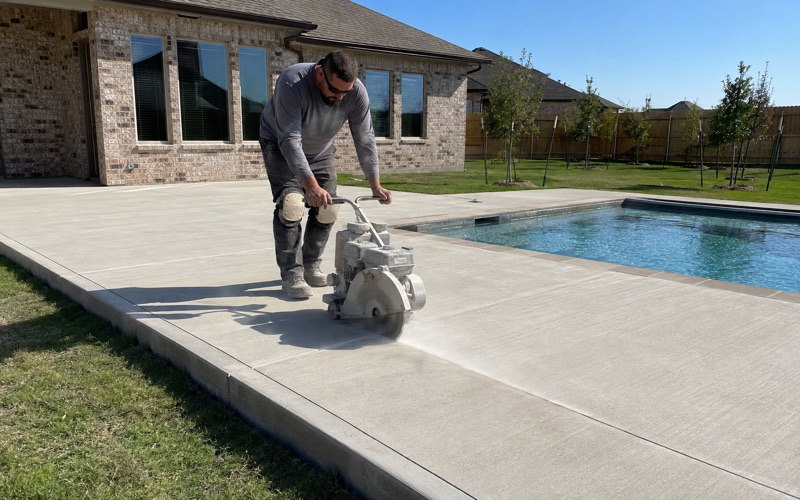
A large pour reads better broken up, and borders, banding and a sawcut pattern do that while also placing the control joints where the slab wants them. Done together, the decorative layout and the joint layout stop fighting each other.

Concrete Patios Built for a Texas Summer

A patio here takes direct sun most of the year, so surface temperature and sealer choice matter more than they would further north. Lighter integral color and an open finish keep it usable barefoot, and the joint layout has to allow for a slab that expands against whatever it abuts. We detail the isolation joint at the house rather than letting the patio push on it.

Pool Deck Finishes That Stay Cool Underfoot

A pool deck has to stay grippy wet and tolerable in bare feet, which rules out a hard trowel finish and argues for a broom, salt or textured stamped surface in a lighter color. Drainage away from the coping matters as much as the finish. We set the slope first and choose the texture second.

Penetrating and Film Forming Sealers

A penetrating sealer such as a siloxane soaks in and repels water without changing the look, while a film forming acrylic or polyurethane sealer sits on top, deepens the color and gives gloss at the cost of needing a reseal sooner. Decorative work here generally wants resealing on a cycle rather than when it starts looking tired. We tell you the interval for the product we put down.

Matching New Decorative Concrete to Old

New concrete never matches cured concrete on the day it is poured, and anyone promising otherwise is selling. Color, aggregate and finish can be matched closely, and the new work drifts toward the old over the first year as it cures and weathers. We set that expectation before the pour rather than explaining it after.

Commercial, Code and Accessibility Work

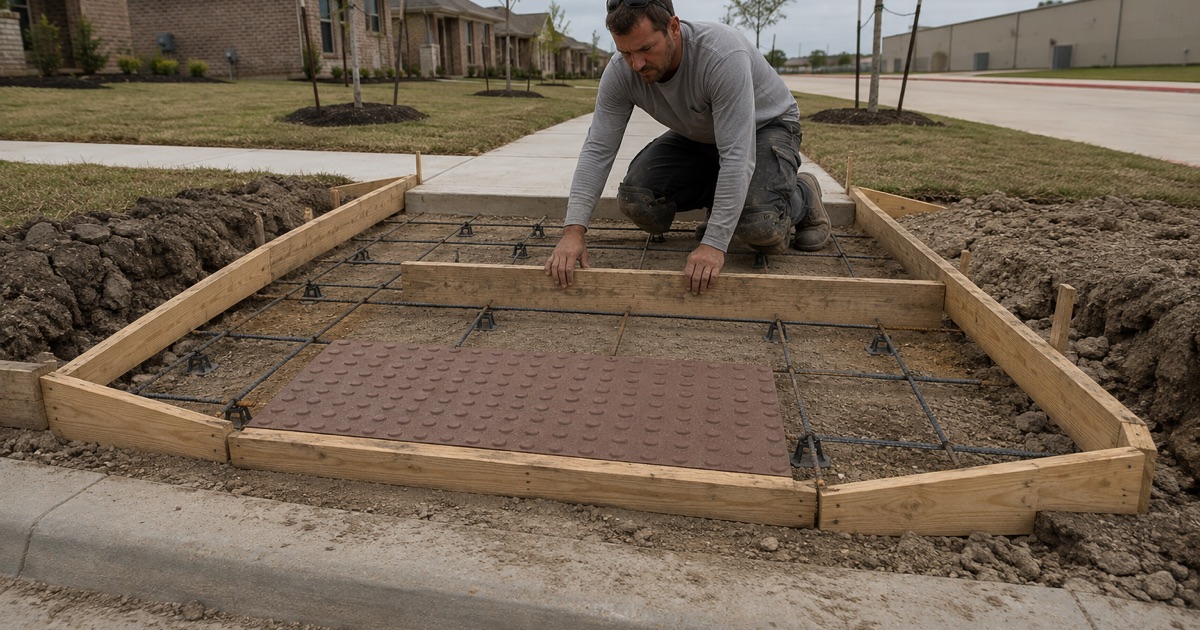
A curb ramp being formed at a commercial drive in Kyle, the flare forms set and the reinforcing bar laid out on chairs before the pour.

Commercial Parking Lots and Truck Drive Aisles

A parking stall and a truck drive aisle are not the same pavement section, and building the whole lot to the lighter one is how a lot fails at the entrance while the parking bays are still fine. We separate the sections, thicken and reinforce where the trucks turn, and detail the joints for the loading pattern rather than the square footage.

Curb Ramps and Detectable Warning Surfaces

A curb ramp is a graded transition with tolerances measured in fractions, and a detectable warning surface with truncated domes marks it for anyone using a cane. Placement, orientation and contrast are all specified, not stylistic. We build built-up and standard ramps to the detail on the plan set and verify them before the inspector does.

Accessible Routes Measured, Not Eyeballed

Running slope and cross slope on an accessible route are checked against Texas Accessibility Standards with a level, because the difference between passing and failing is smaller than the eye resolves. We shoot grades before the pour and check them after, and we hand over the numbers.

Right of Way Sidewalks at the 60 Inch Minimum

Kyle sets right of way sidewalks at a 60 inch minimum width with cross slope held under 2 percent, and the final inspection measures it against Texas Accessibility Standards rather than judging it by eye. There are narrow exceptions, and they are exceptions rather than defaults. We build to the minimum and document the cross slope we achieved.

Curb and Gutter and Valley Gutter Drainage

Curb and gutter, valley gutters and the grades between them are what actually get water off a site, and concrete work that ignores them creates ponding the owner lives with for decades. The gutter line has to be continuous and at grade, which is a survey question before it is a concrete question. We set the flow line and pour to it.

Container Pads Where No City Spec Exists

Dumpster and container pads take a point load from the truck’s rear wheels and a dragging load from the container itself, and many cities publish no standard detail for them at all. Where Kyle does not, we build to ACI 330 guidance for the loading rather than defaulting to a parking section.

Commercial Approach Aprons and Standard Details

A commercial approach apron carries every vehicle entering the site and is the piece most often built to the residential detail by mistake. The plan set has to show the standard detail the city has adopted, including thickness, reinforcing and the turning radius the approach is designed for. We build the apron shown rather than the one that is quicker to form.

Building on the Edwards Aquifer Recharge Zone

TCEQ maps put 26.5 percent of Kyle in the Edwards Aquifer Recharge Zone and 21.4 percent in the Transition Zone, and on the recharge side plan approval under 30 TAC 213 comes before earthwork rather than after it. A water pollution abatement plan and the impervious cover it accounts for drive the schedule. We check the line at the address and build the approval into the timeline.

Areas We Serve

Kyle Elite Concrete provides concrete-contractor throughout the greater Kyle area, with the same crews and the same standards on every job.

Good to know

Frequently Asked Questions

What does a concrete driveway cost in Kyle?

Price follows thickness, reinforcing, square footage and how much demolition and excavation the site needs, and on a driveway it also follows which standard governs the approach. Kyle's residential checklist sets 5 inches and number 3 bar at 18 inches on center, while the adopted standard detail calls for 6 inches and number 4 bars both directions, and that difference is real money. We price the ground and the governing document before we quote.

How long before I can drive on new concrete?

Concrete gains most of its compressive strength over the first month, but the practical question is when it will carry a vehicle without marking. That depends on the mix, the thickness and the weather during the cure, so we give you a date at the time we schedule the pour rather than a rule of thumb. Foot traffic comes considerably earlier than vehicle traffic.

Do I need a permit for concrete work in Kyle?

It depends on what you are pouring and where. Replacing an existing driveway or sidewalk means a right of way excavation permit from Public Works, and foundation work is engineered and permitted because of the expansive soils in Kyle. A patio well inside your own property may need nothing. We identify what your job needs before we start and we pull it.

Why does Kyle inspect flatwork twice?

The city looks once in the right of way before the concrete goes down, and again at final building inspection. The second look is the one that catches cracking and crazing, which Kyle treats as failure conditions rather than cosmetic complaints. We book the first inspection ahead of the truck, because a failed final costs a reinspection fee on top of the original work.

Is rebar really better than fiber or wire mesh?

They do different jobs. Macro synthetic fiber and welded wire reinforcement control shrinkage cracking; deformed bar holds a cracked slab together and carries load across the crack. On a Kyle driveway the choice is not yours or ours to make, because the city bans hog panels, wire mesh and fibrous concrete as substitutes for the bar, and bans broken brick or rock as chairs.

What strength concrete do you use?

Class A concrete at a minimum of 3,000 psi is what the Kyle residential driveway checklist specifies, and we go up from there where the loading or the exposure warrants it. Mix selection also covers water cement ratio, air entrainment, slump and aggregate gradation, all of which show on the delivery ticket. We keep the batch tickets and hand them over.

Can you level my slab instead of replacing it?

Often, yes. Leveling suits a slab that is structurally sound and has simply lost the support under it, and it is faster and cheaper than a tear out. A slab that is broken through, badly scaled or too thin will not survive being lifted. We look at the slab and the void under it and tell you honestly which case you are in.

Do you work on the Edwards Aquifer Recharge Zone?

Yes, and we check which side of the line an address falls on before scheduling any earthwork. TCEQ maps put 26.5 percent of Kyle in the Recharge Zone and 21.4 percent in the Transition Zone, and plan approval attaches on one side and not the other. Building that approval into the timeline is the difference between a job that runs and a job that stalls.

How do you keep new concrete from crazing in the heat?

Crazing comes from the surface drying faster than bleed water can replace it, which Texas heat does easily. We work to the evaporation rate rather than the calendar, using an evaporation retarder and either a curing compound or a wet cure as conditions require, and we time the finishing operations to the set. It is the cheapest insurance on the whole pour.

Are you licensed and insured?

We carry insurance and work to the permits and inspections each job requires, including the engineer sealed designs that Kyle's expansive soils make mandatory on foundation work. Texas does not license concrete contractors as a trade, so the meaningful questions are insurance, permits and whether the contractor builds to the document the city actually enforces. We will show you all three.

Ready to Get Started?

Request a free quote today and we'll get back to you fast.