
Kyle Elite Concrete builds the concrete patio in Kyle, TX that people actually use in August, drawing on more than 20 years of local work and serving surrounding cities including Buda, San Marcos, Manchaca, Shady Hollow, Redwood. A patio here is an outdoor room with a hard deadline of about four months of serious heat, and the design decisions that matter are the ones that affect whether it gets used.
Most of those decisions are made before the pour. How big the slab is relative to the furniture that will go on it, where it meets the house, which direction water leaves it, and how hot the surface gets in direct sun are all fixed on the day it is formed. None of them are cheap to revisit afterward.
We would rather spend an extra visit on layout than pour a patio that is six feet too shallow for a table and chairs. That is the most common complaint we hear about somebody else’s patio, and it is entirely a planning failure rather than a concrete one.
Sizing and Laying Out a Patio
Depth, Furniture and How the Space Gets Used
A dining set with chairs that pull out needs meaningfully more depth than the table footprint suggests, and a grill area needs standing room in front of it that nobody counts until the slab is down. We lay the shape out on the ground with the furniture positions marked before forming, so you are looking at the real space rather than a dimension on paper. Adding two feet at that stage costs a fraction of what it costs later.
Where the Patio Meets the House
The patio has to be separated from the house slab with an isolation joint so the two can move independently, which on Kyle’s expansive clays is not optional. Tying them rigidly together transfers movement straight into the foundation. The elevation at that line also has to sit below the finished floor and slope away, so the joint is doing two jobs at once and both are worth getting right.
Steps, Transitions and Existing Concrete
Where a patio meets a step, an existing walk or an older slab, the transition is where trip hazards and cracking start. Riser heights need to be consistent, and a new slab abutting an old one needs a joint rather than a bond. We detail those connections deliberately rather than pouring up to whatever is there and hoping the two get along.
Finishes, Color and Surface Temperature
Choosing a Finish for Bare Feet and Wet Days
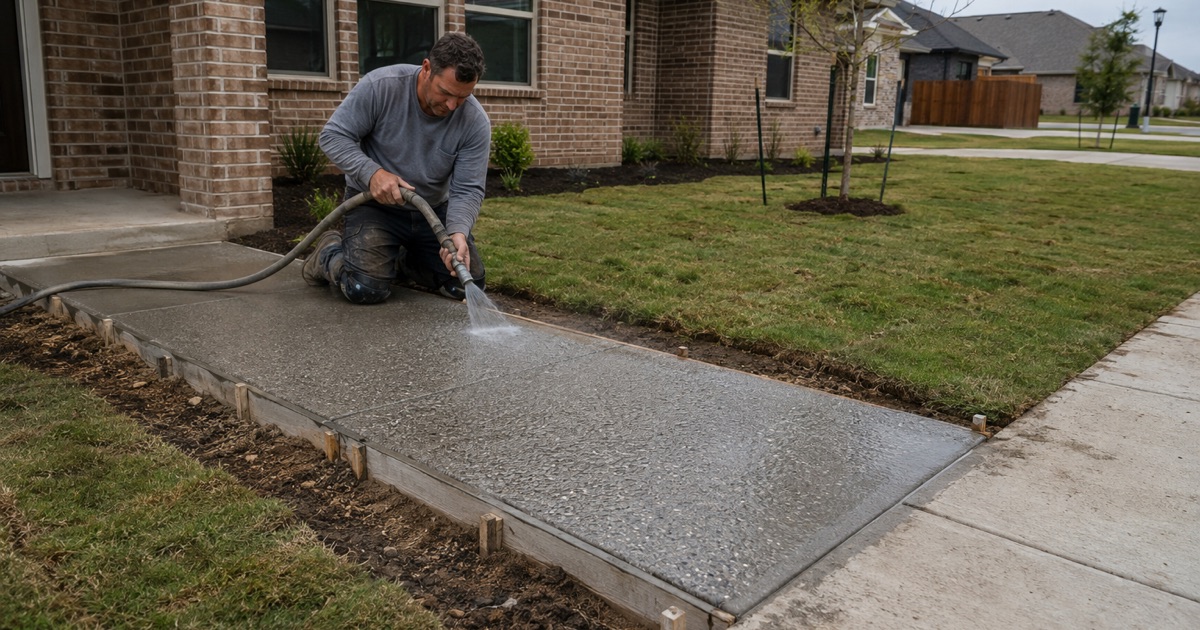
A broom finish gives reliable traction and is the default for good reason, a salt finish opens small pockets that grip without feeling rough, and a hard trowel finish belongs indoors rather than on a patio that gets rained on. Exposed aggregate and stamped textures both work outdoors and change the maintenance picture. We match the finish to who uses the space and how often it gets wet.
Color, Sun and How Hot the Slab Gets
Surface temperature in direct Texas sun tracks closely with how dark the concrete is, and a deeply colored patio in full afternoon exposure can become unusable barefoot in midsummer. Integral color in a lighter range, or a light broadcast hardener, keeps the surface tolerable without giving up appearance. Where shade is coming later from a structure or trees, that changes the calculation and we factor it in.
Sealing a Patio, or Leaving It Unsealed
A plain broom finished patio does not have to be sealed at all, and many are better left breathing. Decorative surfaces are different: color and antiquing need a sealer to hold their appearance, and that sealer becomes a maintenance item on a cycle. We tell you honestly which category your patio falls into rather than selling a coating that adds an obligation you did not want.
Drainage, Joints and Making It Last
Getting Water Away From the Foundation
A patio is a large impervious surface placed directly against a house, which makes its slope a foundation question as much as a comfort one. Water has to leave the slab and keep leaving the property rather than pooling at the wall. Where the existing grade fights that, we say so at the estimate and price the fix rather than pouring the problem in permanently.
Control Joints on a Decorative Surface
Concrete cracks, and control joints decide where. On a plain patio the joint layout is simply spaced to the thickness. On a colored or patterned surface the joints have to be planned alongside the design so they fall on a line that looks intentional. Joints added after a pattern is chosen are the reason many decorative patios look wrong.
Living With Expansive Clay Underneath
Houston Black clay under a patio moves seasonally whatever is poured on top of it, and reinforcing sized and chaired properly is what keeps a slab acting as one piece when it does. Where the ground under a patio is Real gravelly loam instead, the movement is far smaller and the detailing can be lighter. We identify which you have before quoting rather than applying one recipe everywhere.
- 20+ Years in Hays County
- Insured & Permitted
- Free Estimates